What is rubber hose animation?
Rubber hose animation is a cartoon style in which arms and legs bend in smooth curves rather than around clearly defined elbows and knees. Associated with early twentieth-century cartoons, it uses elastic poses, simple silhouettes and expressive movement. Modern artists can create the look with hand-drawn frames or digital rigs: the defining feature is how the character moves, not a particular software package.
An arm curls around a doorway. A body stretches toward a tempting object. A surprised character briefly becomes a completely different shape, then snaps back into place. Rubber-hose animation makes those impossible actions feel like part of the character's world.
This guide explains how to recognise the style, how to plan a readable performance and what modern examples reveal about production. It also separates rubber-hose design from related ideas such as squash and stretch, so you can describe the look you want without prescribing the wrong workflow.
How to recognise the rubber-hose style
Start with the limbs. In a conventional joint-led pose, the upper arm and forearm form a visible angle at the elbow. In a rubber-hose pose, the whole arm can read as one continuous curve. That difference lets the animator turn a gesture into a flowing line, often pushing the silhouette far beyond everyday anatomy.
Rounded bodies, oversized hands and feet, strong outlines and simple faces often accompany the approach. White gloves and pie-cut pupils are familiar historical conventions, but they are not a checklist every modern character must follow. Colour, costume and surface treatment can change while the elastic movement remains recognisable. Adobe's introduction to rubber-hose animation describes the flexible limbs and graphic conventions associated with the early style.
- Look for continuous curves: arms and legs behave like flexible shapes, rather than a series of rigid segments.
- Watch the whole silhouette: the torso, hands and feet support the gesture instead of moving as unrelated parts.
- Check the timing: a held pose, sudden change or repeated rhythm can make an impossible action easy to follow.
- Separate styling from motion: a still image can suggest the aesthetic, but only a sequence reveals the performance.
For a broader comparison with other approaches, explore our guide to cartoon styles. For decisions about the underlying silhouette, see shape language in character design.
Where does rubber-hose animation come from?
The style is closely associated with American cartoons of the 1920s and early 1930s. Early screen characters used simplified graphic forms and highly flexible movement; familiar examples include early Mickey Mouse and Oswald the Lucky Rabbit cartoons. Adobe identifies Oswald's The Fox Chase (1928) as a useful example of the exaggerated limb movement.
It is more useful to understand rubber hose as a visual and performance tradition than to assign every old cartoon to one rigid category. Early films differ in drawing, staging and movement, and later work can borrow selected qualities without reproducing an entire period look.
Keep historical reference separate from permission to reproduce an image. A film's age or a screenshot appearing in search results is not a reuse licence. This article uses separately licensed character artwork, with credits collected below. Our history of cartoon animation covers the wider timeline.
How the movement works: pose, curve and timing
A useful way to study a rubber-hose performance is to ask three questions: what is the character trying to do, which pose makes that intention clear, and how does the body travel between poses? Flexibility gives the animator options, but the audience still needs to understand the action.
Choose the pose before adding flexibility
Imagine a character reaching for an apple just beyond a fence. The first pose establishes the target. A second shows the reach becoming a stretch. A third delivers the result: success, a missed grab or an unexpected recoil. This is a suggested practice exercise, not a description of a Mimic Cartoon client production.
Before adding intermediate drawings, reduce each pose to a silhouette. Can you see the hand, read the direction of the reach and tell where the character is looking? If the arm disappears against the torso, more movement may make the shot busier without making it clearer.
Give the bend a clear direction
For the reaching pose, try one broad curve through the arm rather than several small bends. Keep the hand readable at the end of that curve. Decide whether the torso follows the reach, stays planted or is pulled into the action. Those choices communicate effort and personality.
As a review exercise, compare a version with a still torso against one in which the whole body follows the hand. The first may feel cautious; the second may feel eager. These are creative possibilities to test, not universal meanings attached to a particular shape.
Use timing to reveal the reaction
Try a brief pause before the reach and a different pause after the result. Watch the sequence without sound. If the intention is unclear, adjust the key poses or staging before adding surface effects, extra bouncing or music. An elastic arm is only useful if it helps tell the moment.
Rubber hose versus squash and stretch
Rubber hose describes a style of character construction and movement; squash and stretch describes a way of changing shape during an action. They can work together, but they are not interchangeable terms.
A ball can flatten on impact and lengthen as it rebounds without having any limbs at all. A rubber-hose character can hold a quiet curved-arm pose without noticeably changing the size of its torso. When writing a brief, specify whether you want flexible limbs, overall body deformation, a historical graphic look, or a combination.
Nor is the style restricted to black and white. A monochrome palette can suggest older cartoons, but the movement can be interpreted in colour. Likewise, adding film grain to a conventional character does not automatically create a rubber-hose performance.
Modern examples: games, series and digital puppets
Cuphead: traditional drawings inside a modern game
Cuphead is a prominent modern reference. Studio MDHR identifies vintage cartoons as a central influence on the game, first released in 2017. In Unity's account of its production, the character artwork was drawn and inked on paper, then coloured digitally. The game demonstrates that a contemporary delivery platform does not require a contemporary-looking drawing style.
For a production brief, the useful lesson is to discuss the artwork and implementation separately. A reference might communicate flexible performance and painted backgrounds, while the intended project needs a different runtime, camera or interaction system. Admiring an example does not establish its suitability for every budget or schedule.
The Cuphead Show!: carrying the style into a series
Studio MDHR's own account describes The Cuphead Show! as a rubber-hose cartoon adaptation of its game world. It provides a second reference for how a recognisable visual identity can continue in episodic storytelling. It should not be used as evidence that the game and series share an identical production pipeline.
Skunk: an independently created digital puppet
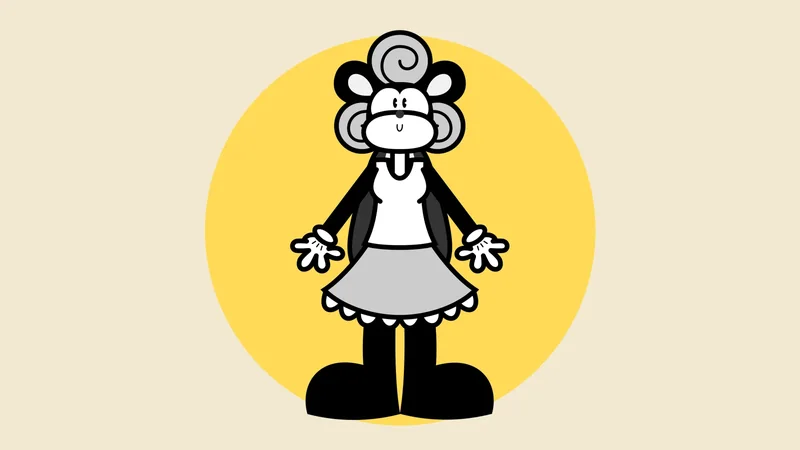
For an accessible example beyond a major franchise, Thomas Fay Syndicate offers Skunk, a rubber-hose-style Character Animator puppet, under Creative Commons Attribution 4.0. The creator describes bendable, draggable arms, blinking and head-turning behaviours. The character artwork illustrates this article; it is not a Mimic Cartoon production or an endorsement.
This example helps distinguish the design from the method. A reusable digital puppet can carry a retro character treatment, while a hand-drawn production can redraw every pose. The right choice depends on the actual performance required.
Hand-drawn or rigged: choosing a production approach
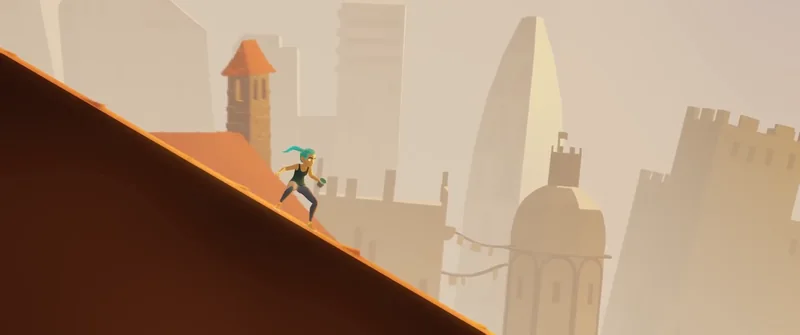
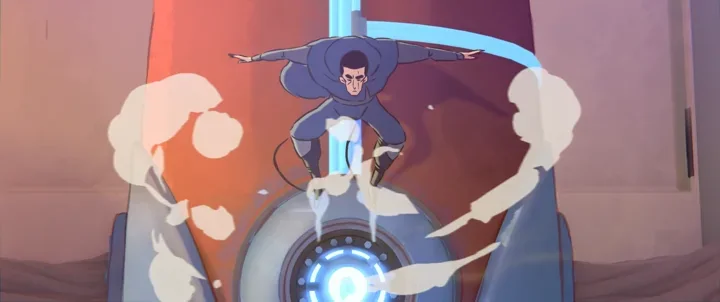
A rooftop action from Blender Foundation’s Coffee Run illustrates clear staging in a stylized 3D production. It is a comparison reference, not an example of classic rubber-hose limb design.
Hand-drawn animation gives the artist direct control over each drawing. It is worth considering when the action involves unusual transformations, changing silhouettes or poses that are difficult to obtain from a fixed setup. Revisions still need to be planned: changing an approved action may affect several drawings and downstream work.
A digital puppet or rig can make repeatable actions and recurring characters easier to organise. The trade-off is that the required bends, turns and expressions must be supported by the setup. Adobe's Character Animator documentation, for example, describes controls for limb bending and stretching. Those controls are tools for a performance, not an automatic substitute for judging the poses.
A 3D interpretation needs its own tests. Specify how the outline should read as the camera turns, how limbs should deform and whether lighting should describe volume or support a flatter appearance. A successful front-view still does not prove that every pose and camera angle will work. Discuss these requirements during character rigging, before approving the final setup.
If the project combines drawn elements with dimensional scenes, our hybrid animation guide explains that broader relationship. Rubber hose is the desired treatment; 2D, 3D and hybrid describe different ways of producing it.
Plan a short test before a full production
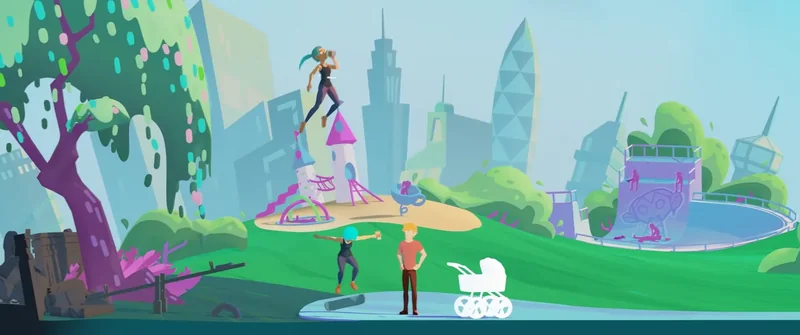
A colourful scene from Coffee Run offers a reference for checking action, silhouette and framing. The film is a Blender Foundation production, not a Mimic Cartoon project.
A focused test can answer more than a long list of reference images. Choose one action that represents the difficult part of the project: reaching around an obstacle, turning while speaking, dancing with a prop or recovering from a fall.
- Write the intention. Describe what the character wants and what changes by the end of the action.
- Choose three readable poses. Establish the setup, the most exaggerated moment and the result.
- Agree the limits. Decide what may stretch or change shape, and what must remain identifiable.
- Test the actual framing. Review the character at the intended screen size and aspect ratio.
- Watch the transition. Check that the action remains clear between the strongest poses, not only in selected stills.
- Record the decisions. Keep approved poses and movement rules with the character files so later shots have a useful reference.
For the apple-reaching exercise, ask whether the hand remains visible against the fence, whether the face shows the target, and whether the return to the resting pose feels intentional. If the character will appear in a game, also test how the action begins and ends when the player interrupts or repeats it.
Include the approved test, intended audience, deliverables and review stages in your animation brief. Describe the degree of exaggeration with examples instead of asking only for “more cartoony.”
When is rubber-hose animation a good fit?
Consider it when physical comedy, a playful personality or an intentionally retro treatment supports the story. It can offer a useful direction for a mascot, music-led sequence or stylised game character, provided the movement feels appropriate for the audience.
Test a different approach when precise anatomy, restrained realism or faithful depiction of a physical task is essential. You can also use a limited amount of elasticity within another style. The decision does not have to be an all-or-nothing commitment to a 1930s appearance.
In a commercial brief, identify what you want the audience to remember: the character, the action or the product. If constant movement draws attention away from that purpose, simplify it. Style should help the message remain readable.
Frequently asked questions
Why is it called rubber hose animation?
The name describes limbs that bend like flexible hoses rather than forming obvious angles at elbows and knees. It refers to the drawn or animated behaviour, not a requirement to use a physical rubber material.
Is Cuphead rubber hose animation?
Yes. Cuphead is a modern reference for the style's revival. Studio MDHR identifies vintage cartoons as an influence, and Unity documents the game's paper-drawn and inked artwork, which was coloured digitally for use in the game.
Does rubber-hose animation have to be black and white?
No. Black-and-white artwork is a familiar historical association, but flexible limbs and elastic movement can also appear in colour. A monochrome palette alone does not make a performance rubber hose.
Can rubber-hose animation be made digitally?
Yes. Artists can draw frames digitally or use a suitable puppet or rig. The setup must support the required curves, expressions and transitions; software alone does not determine whether the movement is convincing.
Is rubber hose the same as squash and stretch?
No. Rubber hose describes a style of character construction and movement, particularly flexible limbs. Squash and stretch changes shape during an action and can be used with many styles, including characters or objects without limbs.
Is rubber-hose animation easier or cheaper to produce?
Not automatically. A simple-looking character may still require demanding poses, transformations and careful timing. Scope depends on the action, number of shots, production method, revisions and deliverables. A representative motion test is more useful than judging cost from a still image.
Conclusion: make the flexibility serve the character
Rubber-hose animation is memorable because it gives a character unusual freedom to act. Curved limbs and elastic shapes matter most when they make an intention, emotion or joke easier to understand. Start with a readable action, test the strongest poses and choose a production method that supports them.
Planning an expressive character? Explore our character animation services or tell Mimic Cartoon about your project. Share the audience, intended platform and a short reference sequence, along with the qualities you like about its movement.
Image credits
Thomas Fay Syndicate - CC BY 4.0; Skunk artwork adapted: optional controller parts omitted, exported, resized and arranged on a background.
Coffee Run - Blender Foundation - CC BY 4.0; film still resized and converted to WebP. Used for comparison and production context, not as a Mimic Cartoon project. No endorsement implied.
Coffee Run - Blender Foundation - CC BY 4.0; film still resized and converted to WebP. Used for comparison and production context, not as a Mimic Cartoon project. No endorsement implied.