
The History of Cartoon Animation and Its Evolution Through the Decades

If cartoon animation were a time-traveling character, it would be the kind that keeps changing outfits mid-scene, rubber-hose arms in one decade, crisp TV outlines in the next, and today’s plush, expressive 3D faces blinking like they’ve got secrets.
The history of cartoon animation isn’t just a timeline of technology. It’s a parade of personalities: mischievous mice, brave princesses, wobbly slapstick heroes, Saturday-morning squads, and cinematic universes with hearts big enough to fill an entire theater. Every decade added new tools, new audiences, and new ways for characters to move like they mean it.
And here’s the fun part: the “evolution” never replaces the past—it remixes it. Classic cartoon charm keeps sneaking into modern pipelines, while modern tech helps stories hit deeper emotional beats than ever before. That’s exactly the kind of character-first magic we love at Mimic Cartoon.
Table of Contents
Silent-Era Experiments and the Birth of Animated Stars

Before cartoons spoke, they danced. Early animation leaned on visual rhythm: looping motion, exaggerated pantomime, and gags that landed like a pie to the face, universal in any language.
Early techniques: hand-drawn frames photographed one by one, often with simplified shapes to make the workload survivable.
Character identity begins: even in rough forms, recurring characters created familiarity an early clue that audiences bond with personalities, not just movement.
Sound arrives and changes pacing: once sound synchronization became practical, timing became an art form. Punchlines could land on a cymbal crash, a squeak, or a perfectly placed beat.
This era laid the foundation for what we still chase today: clear silhouettes, readable emotions, and movement that tells a story even if you mute the screen.
1930s–1940s: The Golden Age and Theatrical Giants

Now the curtain rises, the orchestra tunes up, and cartoons step into theaters like little movie stars. The 1930s and 1940s are often called the Golden Age because studios pushed animation craft at a cinematic scale.
Personality animation takes off: characters stop being “moving drawings” and start feeling like actors with opinions.
Color and richer backgrounds: as production values rose, worlds became more immersive and storybook-like.
Feature-length ambition: long-form animated storytelling proved that cartoons could carry emotion, music, suspense, and wonder for an entire film—not just a quick gag.
This decade-to-decade refinement shaped the language of classic cartoon performance: squashes, stretches, anticipation, and expressive poses that still guide animators, whether they’re drawing on paper or shaping a stylized 3D hero.
1950s–1960s: Television Changes Everything
Television didn’t just give cartoons a new home, it gave them a new schedule. Suddenly, animation had to be produced faster, cheaper, and in higher volume. That pressure created a totally different look and workflow.
Limited animation becomes common: fewer drawings, more held poses, and clever reuse of cycles (walking loops, repeated backgrounds).
Strong design wins: simplified shapes and bold outlines made characters readable at small TV sizes.
Serialized comfort: recurring casts and episodic adventures created rituals, cartoons became something families shared weekly.
Even when the movement was simpler, the best shows leaned on character chemistry and clear staging. That’s a lesson that never expires: you can’t “tech” your way out of weak storytelling.
1970s–1980s: Saturday Mornings, Anime Growth, and New Tones
By the 1970s and 1980s, cartoons were everywhere, on TV, in toy aisles, and in after-school conversations. Meanwhile, Japanese animation grew internationally, bringing different pacing, themes, and visual language.
Saturday-morning culture: cartoons became a big, bright weekly event, often tied to merchandising and recognizable mascots.
Genre expansion: sci-fi teams, fantasy quests, comedy ensembles—animation explored broader worlds.
Anime influence spreads: more serialized storytelling, dramatic framing, and distinct character archetypes began inspiring creators worldwide.
This era proved animation wasn’t a single “style.” It was a toolbox. If you’re exploring that toolbox today, our guide on types of cartoon styles is a fun way to see how many visual languages animation can speak.
1990s: Digital Ink, Prime-Time Cartoons, and the First Big 3D Leaps
The 1990s felt like a creative carnival. TV animation got bolder and stranger, while technology started nudging studios toward digital pipelines.
Digital ink and paint: studios began replacing hand-inked cels with digital coloring systems, improving consistency and speeding up revisions.
Prime-time and auteur-driven TV cartoons: animated shows expanded into satire, teen humor, and more diverse storytelling tones.
Early CGI breakthroughs: 3D animation proved it could carry emotion and comedy, opening a new chapter in character performance.
And once 3D started showing what it could do, the big question became: how do you keep that classic cartoon charm while gaining 3D depth? If you’re curious about that shift, the breakdown of the difference between 2D and 3D animation makes the contrast super clear.
2000s: CGI Becomes Mainstream and Animation Goes Global
In the 2000s, CGI didn’t replace other style, it joined the party and grabbed a microphone. Animated films became major global releases, and TV production pipelines matured across many countries.
3D feature films dominate the box office: studios refined facial rigs, lighting, hair simulation, and cinematic camera language.
Global production pipelines: animation became more internationally collaborative, different teams handling layout, modeling, rigging, or compositing.
Storytelling range grows: from slapstick comedies to heartfelt dramas, animation became less “one genre” and more “one medium.”
This decade also helped normalize the idea that animated characters can live on multiple platforms, movies, games, web series, and interactive experiences, without losing their identity.
2010s: Streaming, Stylized Hybrids, and Internet-Era Cartoons
The 2010s brought streaming platforms, algorithm-driven discovery, and internet-born fandoms. Cartoons became easier to access, and easier to niche down.
Stylization explodes: creators blended 2D linework with 3D spaces, used painterly textures, and played with frame rates for emotional impact.
Short-form and meme culture: animated clips and characters spread fast, often becoming icons outside their original shows.
Bigger emotional ambition: many series leaned into character arcs, mental health themes, and long-form storytelling.
As visuals got more experimental, audiences got more visually literate. They could appreciate a show that looks “simple” but performs with incredible intention.
2020s: Real-Time Tools, Virtual Production, and Performance-Driven Characters
The 2020s are where cartoons start to feel… alive in new ways. Real-time engines, remote collaboration, and performance capture have made character creation more immediate.
Real-time animation previews: creators can iterate faster, seeing changes to lighting, camera, and movement without waiting forever.
Motion capture becomes more accessible: not just for realism, also for expressiveness, helping characters feel grounded even in a stylized world.
Hybrid workflows: 2D and 3D mix freely, and characters can move between film, social content, games, and AR experiences.
If you want the “how” behind those believable performances, this guide on what motion capture means in animation and how it brings characters to life is a great companion to the history of cartoon animation, because it explains the modern heartbeat behind character motion.
Comparison Table
Era / Approach | Typical Look | Common Workflow | Strengths | Trade-Offs |
Silent-era & early shorts | Simple shapes, bold movement | Hand-drawn frame-by-frame | Clear visual comedy, strong timing | Labor-heavy, limited detail |
Golden Age theatrical | Rich backgrounds, fluid acting | Larger teams, cinematic staging | High emotion, iconic characters | Expensive, slower production |
TV limited animation era | Simplified designs, fewer frames | Reuse cycles, held poses | Fast output, readable style | Less fluid motion |
Digital 2D era | Cleaner lines, consistent color | Digital ink/paint + compositing | Efficient revisions, crisp visuals | Can feel “too clean” if not styled |
CGI feature era | Dimensional characters, cinematic lighting | Modeling → rigging → animation → render | Deep performance, scalable worlds | Higher technical complexity |
Hybrid & real-time era | Style variety (2D+3D blends) | Mix of pipelines + real-time iteration | Faster iteration, unique aesthetics | Tooling choices can fragment workflow |
Applications Across Industries

The history of cartoon animation isn’t only a story about entertainment, it’s also a blueprint for how characters communicate. Today, animated characters show up wherever humans need clarity, warmth, or a little spark.
Kids’ storytelling and edutainment series
Family-friendly entertainment brands and mascots
Social media character shorts and interactive episodes
Game characters and animated cutscenes
Training videos and friendly explainer characters
AR filters, virtual hosts, and digital companions
When teams want to build characters across platforms, they often start by understanding what services and production paths exist. That’s where Mimic Cartoon’s services can help frame the creative workflow from concept to animated performance without losing the heart of the character.
Benefits
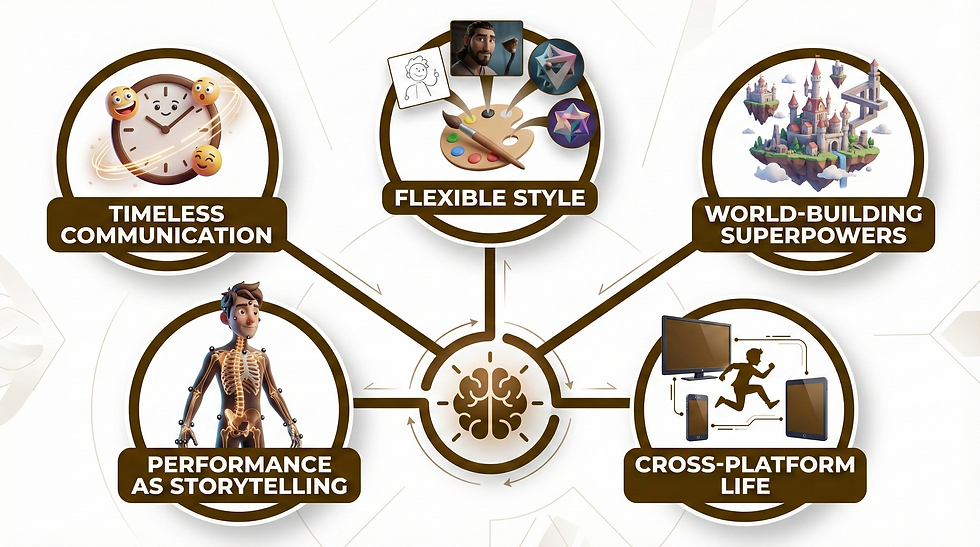
Watching the evolution across decades shows why animation remains one of the most powerful storytelling tools ever invented.
Timeless communication: emotions read instantly through exaggeration and clear acting.
Flexible style: cartoons can be simple, cinematic, surreal, or hyper-detailed.
World-building superpowers: impossible worlds become believable if characters feel real.
Cross-platform life: animated characters can move from shows to games to apps without breaking the spell.
Performance as storytelling: modern motion capture and expressive rigging can deepen the “actor” inside the character.
Challenges
Every era of animation brought its own dragons to fight, some are technical, some are creative, and some are “how do we ship on time?”
Time and labor: animation is love… and love takes hours.
Style consistency: keeping characters on-model across teams and episodes is a real craft.
Tech choices: tools can speed you up or slow you down depending on pipeline fit.
Uncanny risks: more realism can magnify small performance mistakes.
Compositing confusion: audiences may not notice compositing when it’s great, but they feel it when it’s off, especially when mixing VFX and animation. If you want a clean distinction, here’s the difference between VFX and animation.
Future Outlook

If the last century taught us anything, it’s that animation evolves in loops: new tech arrives, artists bend it into style, and storytelling stays at the center like a trusty compass.
AI-assisted workflows (carefully used): more help with cleanup, iteration, and exploration, while artists keep the final “soul choices.”
XR storytelling: characters stepping into AR/VR spaces, where performance must read from every angle.
Real-time character platforms: animated mascots that can respond live, like hosts, companions, or interactive guides.
More expressive 3D characters: better facial capture, nuanced body acting, and stylized realism that keeps the cartoon spirit intact.
For interactive character experiences that feel like conversations, not just animations, some creators explore character-driven interfaces and intelligent character behavior. If that’s your lane, conversational AI is part of the bigger picture of where animated characters may live next.
FAQs
1) What is the “history of cartoon animation” usually referring to?
It’s the timeline of how animated cartoons developed—from early hand-drawn shorts to theatrical classics, TV production, digital pipelines, CGI films, streaming-era styles, and modern real-time workflows.
2) When did cartoons shift from theatrical shorts to TV series?
The major shift happened as television became widespread in the mid-20th century, pushing studios to produce faster and adopt limited animation techniques suited to weekly schedules.
3) Did CGI replace 2D animation?
Not really. CGI became a dominant format for many feature films, but 2D continued and even thrived especially in TV, indie projects, anime, and stylized hybrid productions.
4) Why do older cartoons look “bouncier” than some TV cartoons?
Many theatrical-era cartoons used high-frame-count animation and larger teams, while TV-era production often used limited animation to meet tighter budgets and faster deadlines.
5) What role does motion capture play in modern character animation?
Motion capture records real performance data (body, sometimes face) so animators can build expressive, believable movement—then stylize it to fit the character’s cartoon world.
6) What’s the difference between animation and VFX in modern productions?
Animation focuses on creating motion and performance (especially for characters), while VFX often focuses on integrating effects into live-action footage—though the two frequently overlap in today’s pipelines.
7) How do studios choose between 2D and 3D?
It depends on story tone, production needs, budget, distribution platform, and the desired character feel. Some projects also blend both to get the best of each world.
8) What’s the biggest trend shaping the next decade of animation?
Real-time tools, cross-platform character ecosystems, and performance-driven pipelines are huge, especially when they help characters feel emotionally alive and interactive.
Conclusion
The history of cartoon animation is really the story of characters learning new ways to breathe. From silent-era slapstick to Golden Age theatrical magic, from TV’s bold simplicity to the cinematic glow of CGI, each decade added a new brush to the animator’s paintbox.
But the heart stays the same: a character with something to feel, something to want, and a way of moving that makes us believe in their world—whether it’s drawn in pencil lines or sculpted in stylized 3D. That’s the spirit we keep chasing at Mimic Cartoon: classic cartoon warmth powered by modern craft, so every blink, bounce, and brave little step forward means something.



Comments