
Facial Animation for 3D Cartoon Characters: Expressive Brand Storytelling

Facial animation is where a 3D cartoon character stops looking like a model and starts feeling like a performer. The eyebrows, eyes, cheeks, mouth, timing, and tiny pauses tell the audience whether the character is curious, confident, confused, delighted, nervous, or ready to help.
For Mimic Cartoon, facial animation sits between 3D cartoon character creation, rigging, motion capture, voice, story, and interactive avatar design. It matters for brand films, explainers, product walkthroughs, games, education, websites, and AI characters because the face carries trust before the script has finished speaking.
This guide explains how cartoon facial animation works, what inputs a studio needs, how to plan facial performance for brand use, which mistakes make characters feel flat, and how to measure whether the character is actually helping the story.
Table of Contents
What facial animation means for cartoon characters
Facial animation is the craft of controlling a character's expression over time. In 3D cartoon production, that can include brows, eyelids, pupils, cheeks, lips, jaw, tongue, teeth, head tilt, eye focus, blinks, breathing, and the timing between expressions.
The goal is not simply to move the mouth when dialogue plays. The goal is to make the character think on screen. A believable cartoon face reacts before it speaks, lands a joke with a pause, shows doubt with the eyes, and changes expression when the story changes direction.
Emotional clarity: the audience understands what the character feels in each moment.
Readable speech: lip sync supports voice performance without distracting from the scene.
Brand personality: the face expresses the same tone the brand wants to project.
Reuse value: a strong expression library can support ads, explainers, tutorials, games, and AI avatars.
Facial animation vs rigging, lip sync, and motion capture
Facial animation is connected to several production stages, but it is not the same as all of them. Cartoon character rigging creates the controls. Lip sync matches mouth shapes to speech. Motion capture records a human performance. Facial animation uses those tools to create the final acting choices.
A useful comparison is to think of rigging as the instrument, motion capture as one kind of performance input, and animation as the direction that turns the scene into a character moment. The best results usually combine technical setup with acting judgment.
Rigging: builds facial controls, blend shapes, joints, constraints, and animator handles.
Lip sync: shapes phonemes, jaw motion, mouth corners, and timing around dialogue.
Facial capture: records human expressions for retargeting, cleanup, or reference.
Keyframe facial animation: lets artists push timing, exaggeration, style, and appeal.
Final performance: balances realism, readability, humor, brand tone, and story purpose.

Why expressive faces improve brand storytelling
A brand character can explain ideas more warmly than a static page because it gives viewers someone to follow. That is why facial animation is so important in cartoon mascot design and character-led campaigns. The face turns information into attitude.
For a product video, the character can show the moment of confusion before the solution appears. For onboarding, it can reassure the viewer. For a campaign, it can deliver a memorable reaction. For a website guide, it can make the interaction feel less mechanical.
Awareness: memorable reactions make the character easier to recall.
Consideration: expressions can simplify complex benefits without adding more words.
Conversion: trust-building micro-expressions make the character feel helpful, not pushy.
Retention: a consistent face gives future tutorials and updates a familiar host.
Differentiation: expressive performance separates custom animation from generic visuals.
The facial animation production workflow
A strong facial animation workflow begins long before final shots. It starts with the character's role in the story, the audience, the voice, the level of stylization, and the formats where the character will appear. This is the same production discipline behind how animated movies are made, but scaled for branded, interactive, or campaign-driven character work.
The team should test expressions early. A character that looks appealing in one pose may not smile, blink, frown, speak, or react well once it moves. Early tests reveal whether the model, rig, and facial shapes can support the performance style.
Define personality: decide how the character thinks, reacts, speaks, and behaves.
Build facial controls: create brows, eyes, cheeks, mouth, jaw, phonemes, and corrective shapes.
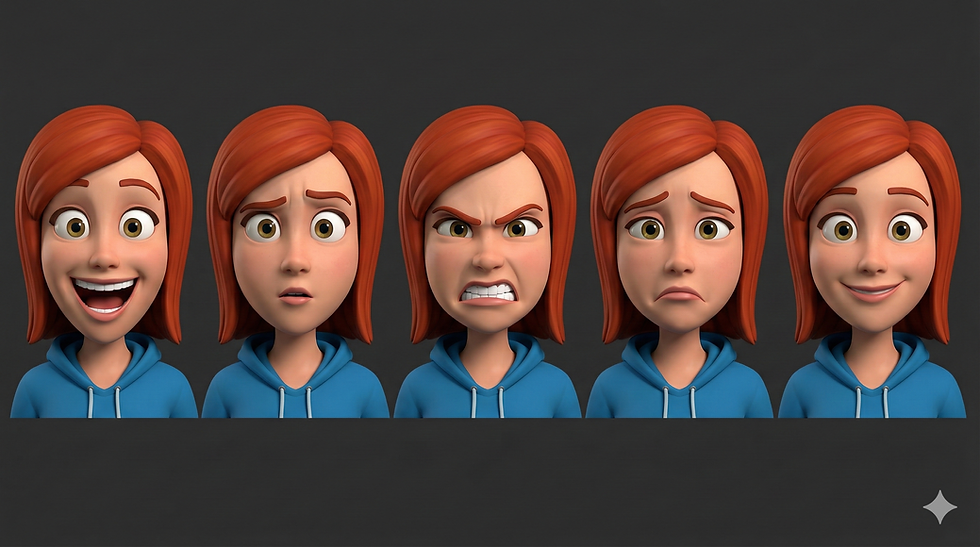
Create expression tests: explore smiles, surprise, concern, focus, laughter, and neutral listening.
Match voice and timing: sync speech while preserving acting beats before and after lines.
Polish shot performance: refine eye focus, blink timing, head motion, asymmetry, and emotional transitions.

Use cases across the customer journey
Facial animation becomes especially valuable when a character appears across multiple customer touchpoints. A face that feels consistent in a hero video, tutorial, product demo, and cartoon explainer video helps the audience recognize the same personality everywhere.
Customer journey planning also prevents over-animation. A playful social clip may need bigger expressions, while a healthcare explainer, education guide, or B2B walkthrough may need calmer timing and more trustworthy eye contact.
Discovery: a strong reaction shot introduces the character and the campaign mood.
Education: facial cues help viewers follow what is confusing, useful, or important.
Comparison: the character can react differently to old and new workflows.
Onboarding: warm expressions reduce friction while explaining steps.
Support: a virtual guide can acknowledge user frustration before offering help.
Loyalty: recurring expressions make seasonal updates and tutorials feel connected.

Data and asset requirements before production
Facial animation quality depends on the inputs. A studio can improvise some performance choices, but the best result comes from a clear brief, a tested rig, voice direction, expression references, and a realistic plan for where the character will appear.
If the project will use motion capture in animation, the team also needs to test how capture data maps onto the cartoon face. Human facial performance often needs stylization before it feels right on a non-human or highly exaggerated character.
Character brief: personality, audience, tone, emotional range, and behavior rules.
Model and topology: clean face loops, mouth interior, eyelids, teeth, tongue, and deformation zones.
Facial rig: brows, lids, cheeks, lips, jaw, phonemes, asymmetry, and corrective poses.
Voice assets: script, recording, timing notes, pronunciation, language needs, and retake plan.
Reference material: expression boards, actor references, brand examples, and styles to avoid.
Platform needs: rendered video, game engine, web avatar, XR scene, or real-time AI interaction.
Mistakes and KPIs to track
The most common mistake is treating facial animation as a mouth-sync task. Viewers do not only watch lips. They read the eyes, brow, posture, pauses, and emotional rhythm. If those parts do not agree, the character feels strange even when the words are technically synchronized.
Another mistake is choosing a visual style without considering performance. Some cartoon styles need broad shapes and simple reads. Others need subtle acting. The facial rig and animation plan should match that style from the start.
Skipping expression tests until late in production.
Using symmetrical faces when the scene needs natural acting asymmetry.
Overusing automated lip sync without animator cleanup.
Letting the eyes drift without clear focus or intention.
Designing a mascot face that looks good in stills but cannot show enough emotion.
Useful KPIs include video completion rate, watch time, replay rate, click-through rate, recall, demo requests, onboarding completion, support deflection, audience comments about the character, retargeting cleanup time, number of reusable expressions, and how many future formats can use the same facial system.

Privacy and responsible AI for interactive cartoon faces
Facial animation now connects with interactive characters, synthetic voices, real-time avatars, and AI cartoon characters. That makes responsible design part of the production brief, especially when a character listens, responds, remembers context, or appears in customer-facing support.
The project should define what the character can say, what it should never claim, when a human should take over, how user data is handled, whether conversations are stored, and how the character signals its artificial nature. Responsible AI is not separate from animation because timing, expression, and eye contact shape trust.
Disclose the character's role when it is interactive or AI-assisted.
Avoid facial expressions that imply certainty when the answer is uncertain.
Set escalation paths for support, medical, financial, legal, or sensitive topics.
Protect voice, face, and user interaction data with clear consent and retention rules.
Keep brand-safe behavior rules connected to both dialogue and animation states.
Future trends in facial animation
The future of facial animation is moving toward reusable expression systems. Instead of creating one finished video and stopping there, studios are building character libraries that include phonemes, reactions, emotion sets, idle loops, and real-time-ready face rigs. This makes the line between CGI and animation more practical: the same character can support cinematic shots and interactive moments.
Better real-time rendering, facial capture, AI-assisted cleanup, localization, and performance retargeting will make expressive cartoon characters faster to deploy. Still, the strongest results will come from fundamentals: clear character development, strong story planning, tested rigs, and early storyboards and animatics.
Expression libraries designed for multiple campaigns and platforms.
Real-time facial rigs for websites, games, XR, and virtual presenters.
Hybrid workflows that combine capture, keyframe polish, and AI-assisted cleanup.
More attention to eye contact, listening states, and trust signals in interactive avatars.
Localized facial performance that adapts voice, timing, and cultural expression cues.

FAQ
What is facial animation in 3D cartoon production?
Facial animation is the process of creating expression, speech, eye movement, blinks, emotional timing, and face acting for a 3D cartoon character.
Is facial animation the same as lip sync?
No. Lip sync focuses on matching mouth shapes to speech. Facial animation includes the full performance of the face, including eyes, brows, cheeks, timing, and emotional transitions.
Why does facial animation matter for brand characters?
It helps a brand character feel trustworthy, memorable, and alive. The face can communicate emotion, confidence, humor, curiosity, and clarity before the viewer processes every word.
Can motion capture be used for cartoon facial animation?
Yes. Facial capture can provide useful performance data, but cartoon characters usually need animator cleanup and stylization so the captured motion fits the design.
What should be prepared before facial animation starts?
Prepare the character brief, model, facial rig, expression references, script, voice recording, brand tone, platform requirements, and any motion capture plan.
How many expressions does a cartoon character need?
It depends on the use case, but practical production often needs neutral, smile, concern, surprise, focus, confusion, excitement, listening, speech shapes, and several transition poses.
Can facial animation support AI avatars?
Yes. Interactive avatars need facial states for speaking, listening, thinking, fallback moments, handoff, and emotional responses that match safe dialogue behavior.
How do you measure facial animation quality?
Measure viewer engagement, completion rate, recall, conversion support, expression readability, revision count, lip sync accuracy, retargeting cleanup time, and reuse across future assets.
What makes cartoon facial animation feel wrong?
Common problems include dead eyes, stiff brows, over-symmetrical expressions, poor lip sync, expressions that do not match the voice, and motion that ignores the character's personality.
Conclusion
Facial animation is one of the most important parts of 3D cartoon character production because it turns design into feeling. A character can be beautifully modeled, but the face is what lets the audience read thought, trust, humor, uncertainty, and intent.
For expressive 3D cartoon faces, mascot performance, lip sync, motion capture cleanup, explainer characters, and interactive avatar production, explore Mimic Cartoon and plan facial animation as a core part of the character system from the first brief.


Comments